
Design, Development, and Disarmament
First thoughts on Magnifica Humanitas

Pope Leo XIV’s first encyclical, Magnifica Humanitas, came out on Monday (but if you’re here you probably already know that). Many Catholics, theologians, and Catholic theologians stayed up very late or woke up very early for the press conference on the encyclical and then began furiously reading through the text. I probably would have done the same, but parenting my beloved 6 year old on a holiday was not conducive to this (and no, she was not interested in my reading it aloud to her).
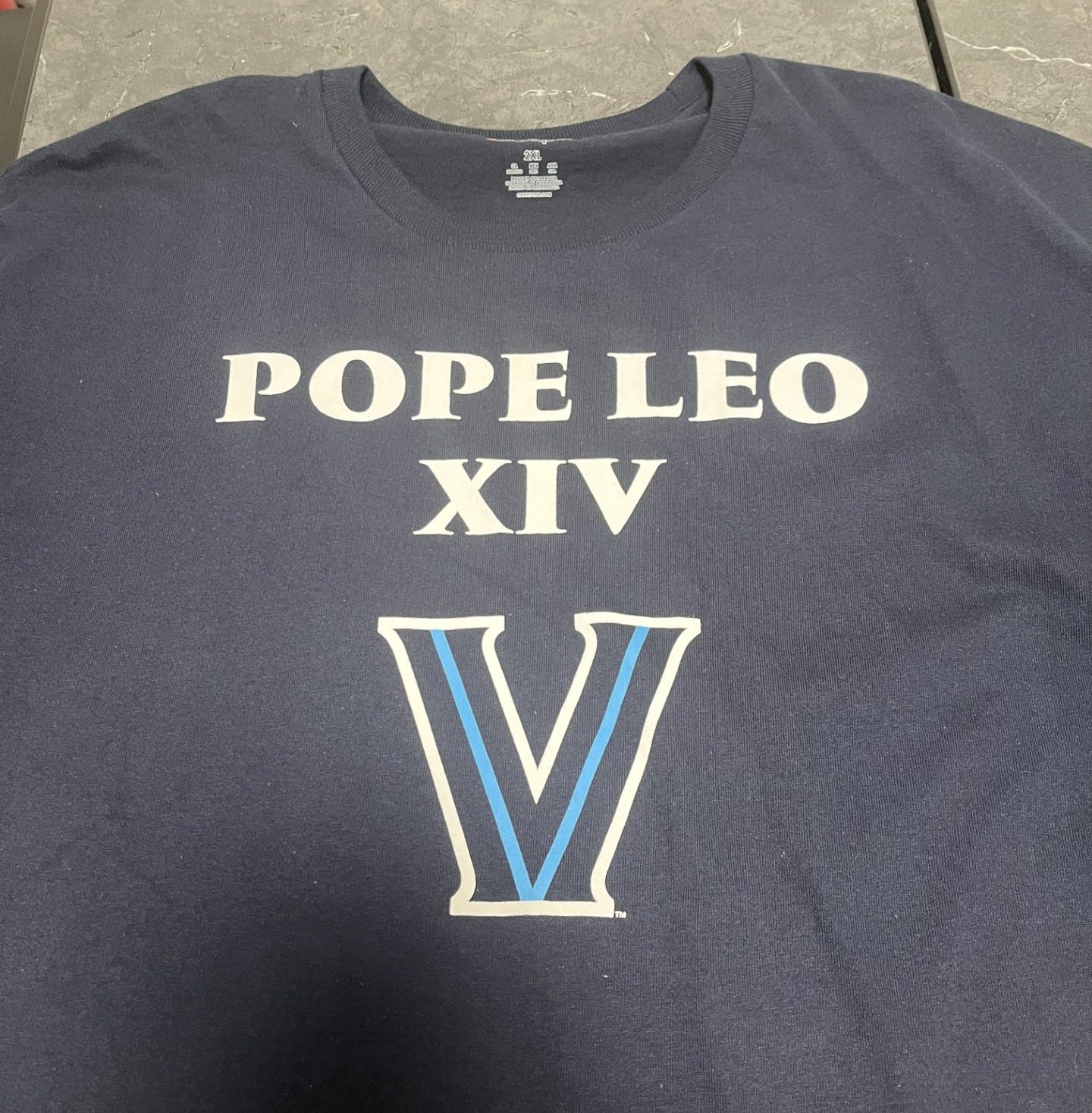
Nonetheless, I finished reading Thursday while on the plane to the College Theology Society’s annual meeting, which fittingly this year is at Villanova University, Pope Leo’s alma mater (as my new shirt reminds you).
A lot has already been said about the encyclical, and there is surely more to say. For my part, I would like to (1) check in on my predictions from last year and (2) offer three themes - Design, Development, and Disarmament - that struck me in reading and reflecting on the encyclical.
Predictions
Loyal readers might remember that last June, I predicted this very thing.
Will Leo XIV write an encyclical on AI?

Last month, after looking through all the early statements, addresses, and homilies of Leo XIV’s young papacy, I made a prediction about a potential encyclical on artificial intelligence:
I was not the only person saying this, but I did (a) give some made up numbers about my confidence in certain predictions and (b) agree to come back and see how I did. These were my four predictions:
Leo XIV will write an encyclical on artificial intelligence (90% confidence, correct)
It will be his first encyclical (50% confidence, correct)
It will be a Catholic Social Teaching encyclical (80% confidence, correct)
It will come out in 2027, self-consciously in the encyclical line of Populorum Progressio (1967) (30% confidence, wrong).

Honestly I’m pretty happy with how I did. If I understood Kalshi, maybe I could have made some money (and then donated it as a penance for using Kalshi).
Three Themes
1) Design
In Magnifica Humanitas, Pope Leo picks up on the critique of the “technocratic paradigm” that Pope Francis identified in his encyclical Laudato Si’. Leo describes the paradigm as “seek[ing] to reduce everything to an object to be dominated” (43) and, more fully, as:
the tendency to let the logic of efficiency, control and profit alone shape personal, social and economic decisions. This makes it clear that technology is not simply a tool. When it becomes the standard by which everything is judged, it begins to dictate what matters and what can be discarded, reducing creation to an object of exploitation and human beings to mere cogs in a system driven toward ever greater efficiency. (92)
The technocratic paradigm shapes how we look at technology, each other, and ourselves. But this is not simply something that happens. A recurring theme in MH is the issue of design. Design decisions are an essential part of artificial intelligence, not only in terms of the algorithms or the data used, but also in terms of access, the financial model, and the concentration of power in a relatively small number of hands. Leo writes “For this reason, ethical discernment cannot be limited to asking whether we are using a system for good or bad purposes; it must also examine how that system is designed and what vision of the human person and society is embedded in the data and models that guide it” (126).
To give an example close to my own heart, there is a good and fair moral question about AI use by students: did they cheat by using AI with this paper, what are acceptable uses, how might this differ among disciplines, etc. There are people at every college and university wrestling with this question. But a more important question is how the systems and structures of higher education design for AI use. Emphasis on degrees as hoops to jump through for jobs turns courses into building blocks of degrees, not as opportunities for learning. The (understandable) emphasis on clearly measurable student outcomes encourages the generation of clearly measurable artifacts from students, which are also easy for AI to generate. As more and more institutions push for AI integration of all kinds in service of job preparation, this will likely continue to embed a design that undermines other significant purposes of education (contrary to Leo’s call for an “authentically integral education” (145)).
Leo calls thus for AI design, development, and deployment to be purposefully ordered to the dignity of the human person and the common good. It’s not sufficient to consider social justice after the fact but rather it must be integrated “from the outset” (109, cf. 145 and 161).
2) Development
My original prediction that the AI encyclical would come out in 2027 as an explicit continuation of the Populorum Progressio line was, again, wrong. However, the central theme of that line, integral human development, is a key part of the encyclical.1 Leo describes this theme as “a process in which the growth of individuals and peoples encompasses all dimensions of existence and opens the future to subsequent generations as well” (82).
Throughout the encyclical, Leo holds onto this integral human development as a moral frame for the evaluation of AI and digital technology. He repeatedly pushes against a technocratic emphasis on efficiency or optimization as the only values at stake. Rather, authentic development is measured by “dignified living conditions, access to necessary goods, just social relations, care of creation and consideration for future generations” (84). Technological development only progresses when accompanied and guided by human development (94).
With respect to AI, the concentration of digital power in a small number of private hands with neither meaningful regulation nor popular participation (95), the significant concerns about the environmental cost of AI (101), and its unfolding, disjointed impacts on education (143-146) are all noted as challenges to integral human development.
Finally, in line with Leo’s emphasis on peace throughout the first year of his papacy, he recalls Pope Paul VI’s claim that development is “the new name for peace.”2 This leads me to the third theme.
3) Disarmament
In his last World Communications Day message in 2025, Pope Francis wrote on the “need to ‘disarm’ communication and to purify it of aggressiveness.”3 Leo has returned to this language over the first year of his papacy: in his May 12 address to the media, he referred to “disarmed and disarming communication, while in his first message for the World Day of Peace he wrote of an “unarmed and disarming” peace. Now in the encyclical, he continues to expand this theme of disarmament.
Most notably, when Leo proposes five daily and public actions that we can all take, the first of these is “the need to disarm words” (213). He writes of this that
We must all, therefore, examine our conscience regarding the words we use, the prejudices we have and the explicit or implicit aggression that lies within them. We have a real opportunity to contribute to the common good each time we speak the truth, offer wise advice, support those in need of comfort, denounce injustice and give a voice to the voiceless. (214)
Second, the encyclical has an extended section on peace and war. He critiques the shift away from disarmament by the major powers of the world and the “troubling revival of war as an instrument of international politics” (190). In one of the more commented on passages of the encyclical, Leo writes
It is in this context that humanity is slipping into a violent culture of power, where peace no longer appears as a responsibility to be taken on, but as a fragile interval between conflicts. Today, more than ever, without prejudice to the right to self-defense in the strictest sense, it is important to reaffirm that the “just war” theory, which has all too often been used to justify any kind of war, is now outdated. Humanity possesses far more effective and capable tools for promoting human life and resolving conflicts, such as dialogue, diplomacy and forgiveness. The use of force, violence and weapons reflects a relational poverty that always has disastrous consequences for civilian populations. (192)
I think there’s a lot more to be said on Leo and the state of the just war theory than I can get to here, but the best read of it I’ve seen is from Deacon Steven Greydanus, who argues that Leo is doing to the just war what John Paul II did to capital punishment.
Finally, Leo talks specifically about disarming artificial intelligence. This in part means moving away from the “arms race” mentality around AI that is evident both among the companies working on AI and also among various countries, especially the United States and China. But, back to the technocratic paradigm, he describes disarming AI as
To disarm means discrediting the assumption that technical power automatically confers the right to govern. To disarm does not mean rejecting technology, but preventing it from dominating humanity. It means freeing technology from monopolistic control and opening it to discussion and debate, therefore making it human-friendly and restoring it to the plurality of human cultures and ways of life. (110)
Put another way, disarming AI is an essential step for managing the technology in light of integral human development.
In all three of these senses, the goal of disarmament is not about eliminating AI or eliminating legitimate self defense or eliminating words. Rather, it is about an orientation to peace, protection of human dignity, and promotion of the common good. These are what should really drive our words, weapons, and algorithms.4
Thanks for reading! I hope to have more to say on a few specifics about the encyclical in the coming weeks, and I hope to be more consistent in posting in general.
For example, going by references in the footnotes, there are 22 citations to Rerum Novarum and its anniversary texts and 31 to Populorum Progressio and its anniversary texts.
Sources cited in the Rerum Novarum line: Centesimus Annus (10), Laborem Exercens (5), Rerum Novarum (2), Octogesima Adveniens (2), Quadragesimo Anno (1), Mater et Magistra (1), and Pius XII’s Radio Message from 1941 (1)
Sources cited in the Populorum Progressio line: Caritas in Veritate (15), Sollicitudo Rei Socialis (9), Populorum Progressio (7)
My full parsing and breakdown of the footnotes can be found here.
Paul VI, Populorum Progressio, 76 (really the section heading above 76)
I wrote at the time that Francis was calling on us to “beat out tweets posts into ploughshares.”
There is a good piece by my pal John Slattery in Commonweal that focuses on the disarmament language.